
Blog 3








Watchmakers in painting
Introduction
The figure of the watchmaker holds a significant place in European visual culture, especially in 19th and 20th century painting. Artists depicted watchmakers not only as skilled craftsmen, but also as symbolic figures reflecting the human relationship to time, tradition, and precision.
Character display
Most often, he is depicted as an elderly man with a beard, wearing magnifying glasses, sitting at a workbench. His posture is focused, his expression thoughtful. He is immersed in delicate mechanical work, and every movement expresses calm concentration. He is not just a technician, but a person whose life revolves around the mastery of timekeeping.
Visual environment
In most paintings, the watchmaker is surrounded by typical workshop elements: wall and...
The figure of the watchmaker holds a significant place in European visual culture, especially in 19th and 20th century painting. Artists depicted watchmakers not only as skilled craftsmen, but also as symbolic figures reflecting the human relationship to time, tradition, and precision.
Character display
Most often, he is depicted as an elderly man with a beard, wearing magnifying glasses, sitting at a workbench. His posture is focused, his expression thoughtful. He is immersed in delicate mechanical work, and every movement expresses calm concentration. He is not just a technician, but a person whose life revolves around the mastery of timekeeping.
Visual environment
In most paintings, the watchmaker is surrounded by typical workshop elements: wall and...
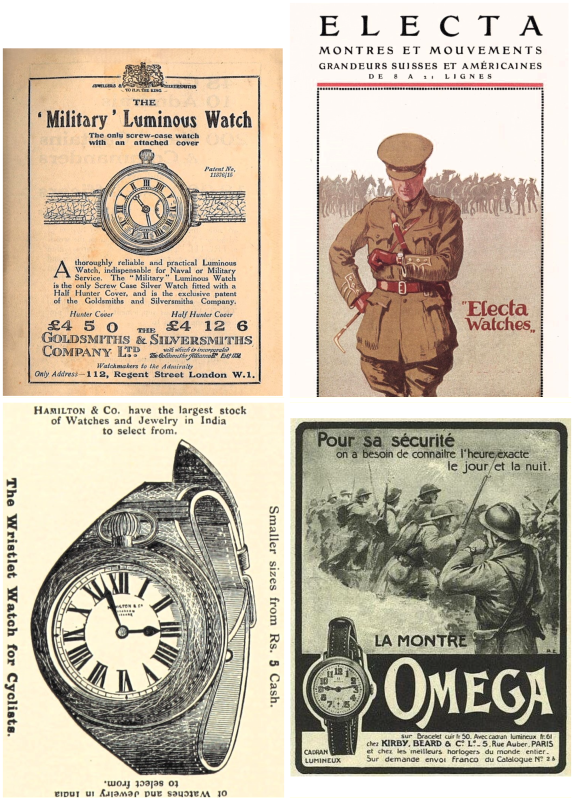
Wristwatches at war
The military was among the first to adopt wristwatches on a large scale. During World War I, commanders faced difficulties coordinating across vast fronts, and pocket watches proved impractical. Wristwatches became indispensable – they were easy to read and essential in the trenches.
Prototypes of wristwatches appeared as early as the 19th century. It is said that officers of the Imperial German Navy originally sewed pocket watches onto their sleeves. In 1879, Girard-Perregaux presented a prototype wristwatch at the Berlin Fair, which so impressed Emperor Wilhelm I that he ordered 1,000 for the navy. By 1880, about 2,000 naval officers were wearing similar wristwatches.
In 1898, Louis Cartier created the first wristwatch for women. In 1904...
Prototypes of wristwatches appeared as early as the 19th century. It is said that officers of the Imperial German Navy originally sewed pocket watches onto their sleeves. In 1879, Girard-Perregaux presented a prototype wristwatch at the Berlin Fair, which so impressed Emperor Wilhelm I that he ordered 1,000 for the navy. By 1880, about 2,000 naval officers were wearing similar wristwatches.
In 1898, Louis Cartier created the first wristwatch for women. In 1904...
Often purchased together