


In an age before satellites, digital instruments, and atomic timekeeping, navigation depended on one critical variable: precision. For pilots crossing vast distances with little visual reference, even a small timing error could mean being miles off course. The solution came not from electronics—but from ingenuity. And one of the most elegant answers to this challenge was the Longines Weems Second-Setting Watch.
Developed in collaboration with American naval officer and navigator Philip Van Horn Weems, this watch was not designed for style or status. It was built as a scientific instrument—one that allowed pilots to synchronize their time with extreme accuracy, a necessity for celestial navigation.
To understand the importance of the Weems system, you need to understand the problem it solved. In the early 20th century, navigation—especially over oceans—relied on celestial observations. Pilots and navigators used a sextant to measure the position of stars or the sun relative to the horizon. But these measurements were only useful if paired with exact time. Even a deviation of a few seconds could translate into significant navigational error.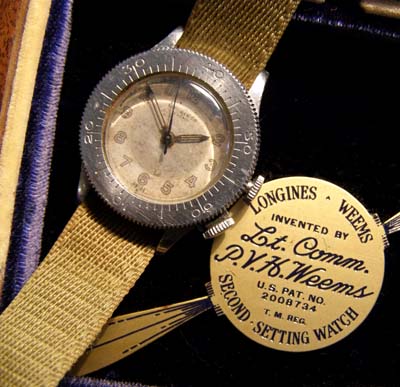
The difficulty was that traditional watches didn’t allow for precise second synchronization. You could adjust the minute and hour hands, but aligning the seconds exactly with a known time signal—such as a radio broadcast—was nearly impossible. This is where Weems’ innovation came into play.
The Longines Weems Second-Setting Watch introduced a rotating inner seconds bezel. Instead of hacking the movement (which most watches at the time could not do), the user would listen to a radio time signal and, at the exact moment, rotate the bezel to align the seconds marker with the running seconds hand. In effect, the watch itself continued running uninterrupted—but the display of seconds became perfectly synchronized.
It was a simple idea, but incredibly powerful. It allowed pilots to achieve a level of precision previously unavailable with standard wristwatches. This innovation turned the watch into a true navigational tool.

Longines brought this concept to life in the 1930s, producing watches that combined robustness with clarity. Large, legible dials, bold Arabic numerals, and oversized crowns made them easy to operate—even in challenging cockpit conditions. The design prioritized function above all else, reflecting the watch’s role as an instrument rather than an accessory.
The Weems system quickly gained recognition among aviators. It was used by some of the most important figures of the era, including Charles Lindbergh, who would later collaborate with Longines on his own Hour Angle watch—another landmark in aviation timekeeping.
What makes the Weems watch particularly fascinating is how it represents a transitional moment in horology. It bridges the gap between traditional mechanical watchmaking and the emerging needs of modern navigation. Before hacking seconds became standard in tool watches, before quartz precision, before GPS—there was this mechanical workaround that solved a real-world problem with elegance.
Over time, technological advancements made such solutions less necessary. Quartz watches, and later digital systems, rendered manual synchronization methods obsolete. But the importance of the Longines Weems Second-Setting Watch remains.
Today, it is appreciated not only as a historical artifact but as a symbol of problem-solving through design. It reminds us that true innovation is not always about adding complexity—sometimes it’s about rethinking the way we interact with existing systems.
For collectors and enthusiasts, the Weems watch represents purity of purpose. Every element, from its rotating bezel to its legible dial, serves a function. There is no excess, no decoration for the sake of decoration—only precision, clarity, and intent.
In a world now defined by instant accuracy, it’s easy to forget how hard precision once was. The Weems watch doesn’t just tell time—it tells the story of how humans learned to measure it, master it, and rely on it when it mattered most.