


In watch design, true breakthroughs are rare. Most innovations are incremental—slight refinements of what already exists. But every so often, a watch appears that challenges the entire visual language of the industry. Heuer Monaco is exactly that kind of watch.
When Heuer introduced the Monaco in 1969, it didn’t just launch a new model—it redefined what a chronograph could look like. At a time when nearly all watches were round, conservative, and traditional, the Monaco arrived with a bold square case, sharp lines, and an unapologetically modern presence. It was controversial, misunderstood, and ahead of its time.
The story of the Monaco begins with a technical revolution. In 1969, Heuer—alongside partners in the Chronomatic group—developed one of the first automatic chronograph movements, the Calibre 11. This was a major milestone: until then, chronographs were almost exclusively manual-wind. The Calibre 11 combined a micro-rotor base movement with a chronograph module, creating a new generation of self-winding chronographs.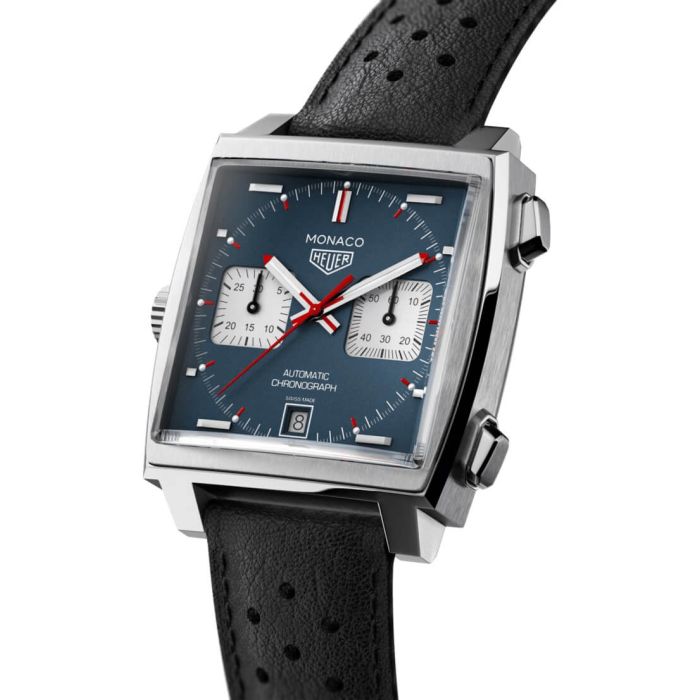
But Heuer didn’t stop at innovation inside the case. They decided the exterior should reflect this same forward-thinking spirit. The result was radical: a square, water-resistant case—something that was extremely difficult to engineer at the time. Traditional round cases naturally resist pressure; square ones do not. Achieving water resistance in this geometry required new construction techniques, making the Monaco not just visually daring, but technically ambitious.
Another unconventional detail was the crown placement. On early Monaco models, the crown was positioned on the left side of the case—a subtle but symbolic gesture. It suggested that the watch did not need to be manually wound, emphasizing the automatic nature of the movement. This small design decision became one of the Monaco’s defining traits.
Visually, the watch was unlike anything else on the market. The deep blue dial, bold square case, and high-contrast subdials created a striking, almost futuristic aesthetic. It felt less like a traditional watch and more like a design object from a different era—one that hadn’t arrived yet.
Despite all this innovation, the Monaco was not an immediate success. Its unconventional shape and avant-garde styling made it difficult for the market to accept. In an era dominated by classic designs, many buyers simply weren’t ready for such a bold departure.
Everything changed, however, when Steve McQueen wore the Monaco in the 1971 film Le Mans. On screen, the watch became inseparable from the world of motorsport—raw, technical, and authentic. McQueen didn’t just wear the Monaco; he turned it into a symbol. From that moment on, the watch gained a cultural identity that transcended its initial commercial struggles.
Over time, what was once considered too radical became iconic. The square case, initially a risk, became the Monaco’s greatest strength. It stood apart in a sea of round watches, offering something unmistakable and instantly recognizable.
Today, Heuer Monaco is regarded as one of the most important design statements in watchmaking history. It proved that form could challenge convention without sacrificing function, and that innovation isn’t limited to mechanics—it can be visual, emotional, and cultural.
The Monaco didn’t just introduce a square case. It legitimized it. And in doing so, it opened the door for future experimentation in watch design—reminding the industry that sometimes, the boldest ideas take time to be understood.